






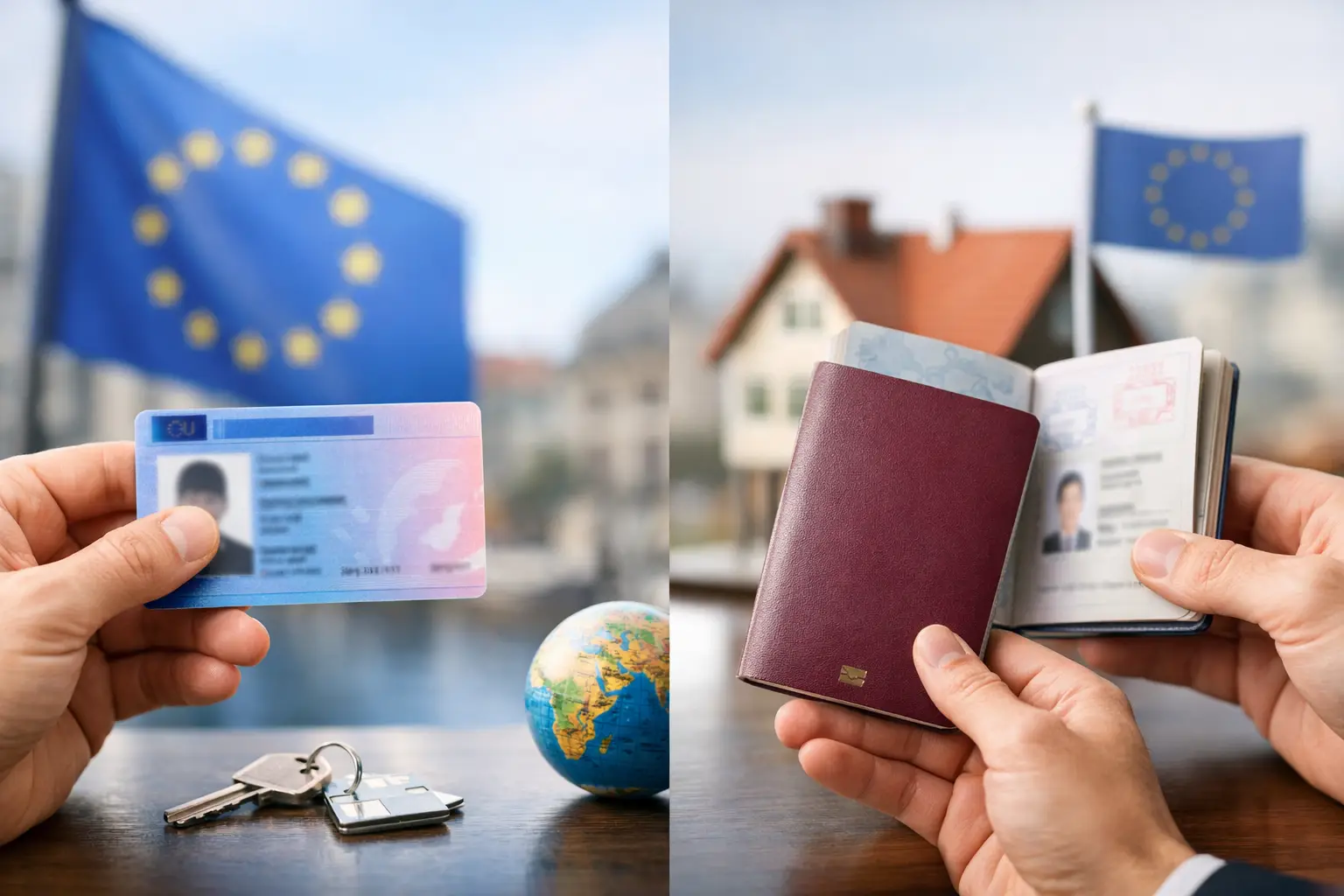
EU Residency Versus Citizenship Explained
If you are investing €250,000 or more into European real estate, the distinction between eu residency versus citizenship is not a technical detail. It changes what you can do, where you can live, how your family is covered, and what level of long-term access you are actually buying.
For many non-EU investors, residency is the smarter first move. It is faster, more practical, and often tied directly to a qualifying property purchase. Citizenship sits in a different category. It usually requires more time, deeper physical presence, language integration, and a broader legal commitment to the country involved. If your immediate goal is mobility, family security, and a stable foothold in Europe, confusing the two can lead to the wrong strategy.
EU residency versus citizenship: the core difference
EU residency gives you the legal right to reside in a specific EU country under that country’s immigration rules. In investment-based routes, this right is often connected to maintaining a qualifying asset, such as real estate. You are not becoming a national of that country. You are securing permission to live there, and in many cases, to access the Schengen Zone more freely.
Citizenship is far broader. It makes you a legal national of the country. That usually means you receive a passport, full political rights in that state, and the right to live and work across the European Union as an EU citizen.
This is where many investors make an expensive assumption. Buying property in Europe does not normally make you a citizen. It may qualify you for residency. That can still be highly valuable, but it is not the same product, not the same timeline, and not the same legal result.
What residency gives you right now
For investors and internationally mobile families, residency often delivers the benefits that matter most in the near term. It can provide legal residence in the issuing country, family inclusion, and access to travel across the Schengen Area, depending on the structure of the permit.
In Greece, for example, qualifying real estate investment can provide a direct route to residency through the Golden Visa framework. That matters because the value is immediate and tangible. You are not waiting a decade to see whether your plan works. You acquire a qualifying property, complete the legal process, and secure residency status tied to a real asset.
That is especially attractive for buyers who want three outcomes from one transaction: a Mediterranean property, a government-backed residency outcome, and broader European mobility. For many families from Turkey, Lebanon, Israel, China, and other non-EU markets, that combination is more relevant than a distant citizenship promise.
What citizenship gives you that residency does not
Citizenship gives permanence at a different level. It generally removes the need to renew immigration status, and it usually carries full EU free movement rights. You are no longer a foreign resident with a permit. You are a citizen with constitutional standing in that country.
That has obvious appeal. A citizen can usually vote, hold a passport, pass nationality rights under certain rules, and live and work throughout the EU without needing a separate immigration route. If your goal is complete European integration, citizenship is stronger.
But stronger does not always mean better for your current objective. If your priority is preserving capital, securing family residency, and creating optionality without uprooting your life, residency may be the more efficient structure. You do not need to buy more than you need.
EU residency versus citizenship for investors
The real question is not which status sounds better. It is which one fits your timeline, risk tolerance, and lifestyle plan.
If you run an international business, split time across multiple countries, or want a European base without full relocation, residency is often the cleaner solution. It can be obtained faster, with fewer behavioral requirements, and with an investment you can analyze like any other asset purchase. In the Greek market, that can mean acquiring qualifying property from €250,000 while targeting both residency rights and income potential.
Citizenship is usually a second-stage decision, not a starting point. It tends to require years of lawful residence, actual physical presence, tax analysis, language competence, and proof of integration. Some investors are happy to meet those conditions. Others are not looking for a new nationality at all. They want access, stability, and flexibility. Residency serves that need exceptionally well.
Travel, family, and lifestyle implications
One reason residency programs attract serious capital is that they solve real family planning problems. Parents want easier travel. They want a stable backup jurisdiction. They want children to have stronger international options. They want an asset in Europe that is not only attractive, but useful.
Residency can answer those concerns quickly. Depending on the program, spouses, children, and sometimes dependent parents can be included. That changes the conversation from an individual visa application to a family mobility strategy.
Citizenship can eventually offer more complete rights, but the route is longer and less predictable. If your child is approaching university age or your family needs a near-term European base, waiting years for a citizenship outcome may not align with your actual priorities.
The property factor matters more than most buyers think
In investment migration, the legal status is only half the decision. The asset matters just as much.
If residency is tied to real estate, you should evaluate the purchase as both an immigration tool and an investment. Location, resale strength, rental yield, title clarity, and ongoing support are not secondary details. They determine whether the investment remains attractive even beyond the residency benefit.
This is where Greece stands out for many buyers. Compared with higher-threshold programs elsewhere, the entry level can be more accessible while still delivering permanent residency rights through a qualifying purchase. And if the property is in a desirable lifestyle market such as Aegina, the investment carries an emotional and practical dimension that many buyers value. You are not parking money in an abstract scheme. You are owning a tangible piece of coastal Europe.
Common misconceptions that cost investors time
The first misconception is that residency automatically leads to citizenship. Sometimes it can contribute to that path, but it is not automatic. Each country sets its own naturalization rules, and those rules often involve years of residence and meaningful local ties.
The second is that all residency programs are equal. They are not. Some require frequent renewals. Some expect actual residence. Some offer stronger family inclusion than others. Some are more administratively efficient. Investors should compare not only the headline threshold, but the practical experience from purchase to permit issuance.
The third is that the cheapest qualifying asset is the best choice. A low entry number may look attractive at first, but poor asset quality can undermine the entire strategy. The right purchase should support your immigration objective while preserving long-term value.
Which route is right for you?
If you want immediate legal residence in Europe, family coverage, Schengen mobility, and a real estate asset you can hold for lifestyle and income reasons, residency is often the most disciplined decision. It is direct, measurable, and aligned with how many global investors prefer to structure cross-border moves.
If your goal is a European passport, full political rights, and the ability to live and work anywhere in the EU without immigration conditions, citizenship may be the long-term destination. But it is rarely the first step, and it should not be confused with what a property purchase delivers today.
For most buyers considering Greece, the real advantage is clarity. You can invest in a qualifying property, secure residency through a defined legal process, include your family, and create a durable base in Europe without overcomplicating the objective. That is why firms such as Mayas Development IKE position the offer around certainty: one acquisition, one guided process, and one clear residency outcome backed by a tangible asset.
The best decision is the one that matches your life now, not the one that sounds biggest on paper. If Europe is part of your family’s long-term plan, start with the status that gives you usable access, solid protection, and room to expand your options later.